

THE HARP is an instrument which for too, too many raises only connotations of the super-ethereal – Galadriel in some enchanted forest, in luxuriously trimmed green velvet, picking out a glissando. Oh, there’s possibly even a waterfall.
But there is so, so much more to the history of the harp in the leftfield that’s vital, seductive, exploratory, than that. One only has to take a deep dive into Joanna Newsom’s Ys, her massive, ambitious, eccentrically melodious album recorded with arrangements by Van Dyke Parks; it’s coming from somewhere else in the sonic scheme of things entirely.
In the world of jazz, there’s the light-touch brilliance of Dorothy Ashby who, on albums such as Hip Harp and In A Minor Groove, combined with the flautist Frank Wess to pull cool late 50s’ jazz in a more exotic tonal direction.
And of course there’s Alice Coltrane, who raised the game to a whole new spiritual level on albums such as P’tah The El Daoud and Journey In Satchidanda. Just check out the majesty with which the harp enters proceedings on the title track to this latter and be blown away.
We can add to this list of leftfield harp greats Mary Lattimore, who’s been incredibly productive over the past couple of years, both under her own name and in two-handed, collaborative conversation with like minds; last year she released New Rain Duets, a harp and piano album with Merge co-founder Mac McCaughan; two years back she worked with psych-folk singer and former member of Espers, Meg Baird, on Ghost Forests; her last solo set, Hundreds Of Days, also from 2018, was beautiful to the point of actually tearful in places.
She’s also toured extensively – I was so lucky to catch her in support to Marissa Nadler one quiet evening at the arts centre in Exeter. And it was being out on the road that led her, serendipitously, to the working relationship and far-flung (certainly in Los Angeles terms) location for the creation of Silver Ladders.
It was at a festival that she happened to encounter Neil Halstead of the wonderful and fully rejuvenated Slowdive. “A friend introduced us because she knew how big of a fan I was and Neil and I had a little chat … the next day, I just thought maybe he’d be into producing my next record.” Turns out he was of a like mind. She flew down to Newquay, the surf capital beetling along Cornwall’s jagged northern coasts, where Neil has been based since his days in Mojave 3.
Silver Ladders was put together at Neil’s studio on one of the Second World War airfields that festoon the high arable plains set just back from the rugged cliffs. He was at the controls and, as we shall see, also stepped out front to add a little of his guitar grace.
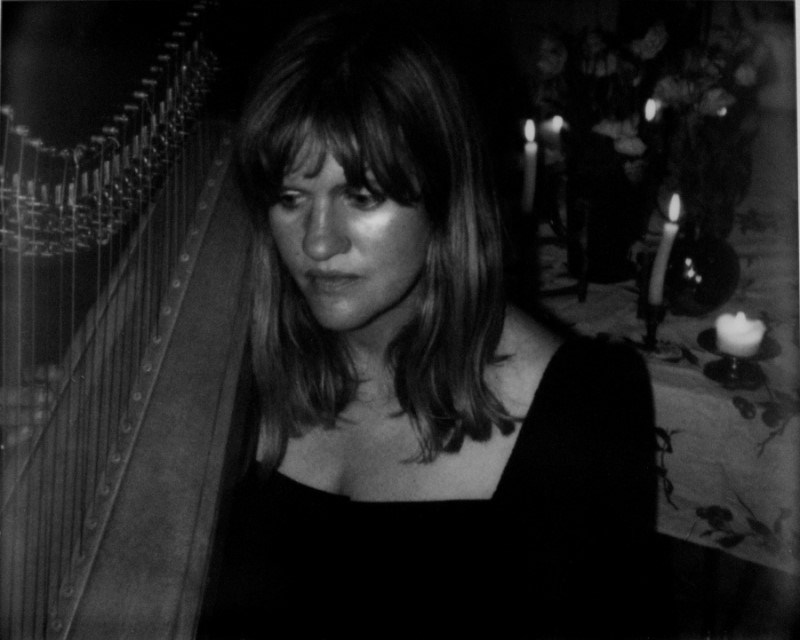
Proceedings open with the paced flourishes of “Pine Trees”, Mary alone save for the coloration of a muted synth wash to flesh out a melodic counterpoint. It has a courtly mantra, and in its lilting reel reminds me of moments from Cornish genius Aphex Twin’s Selected Ambient Works Volume II. It glitters like the Atlantic on a still day. It’s also got this sense of the diachronic: it seems to exist in both this time and yet in some other world, almost separate.
Mary is on record as saying that the track “… is named after a quiet cluster of trees by the sea on the island of Hvar in Croatia.
“This song feels like a testament to [Neil’s] producing in that, through more objective listening, a subtler light could shine through that I hadn’t seen in it before.”
The title track is the second of the seven. It’s one of the three pre-existing tunes that Mary brought to Cornwall with her, and stems from a visit to the island of Hvar, in Croatia. “I spent some days there just swimming in the bay, silver ladders right into the sea,” she recalls; the image became fixed as a leitmotif. Much later, back home, performing at a wedding on the Pacific coast, the image refracted back to her in song.
“Before anyone showed up, I had time to set up and play and this song came to me; I made a little recording on my phone to remember it.”
What begins in a similar place to the preceding “Pine Trees”, with that lambent delicacy, plays into a more intricate, evocative place. It descends with the pace of an ocean swell; you feel it surge and crest at a pace which is just off the absolute linear. That delicate synth color begins to foam, high-tide in a resonance that almost feeds back in the climaxing crescendo. If you’re an old-skool indie kid, let alone the obvious ambient comparison of Slowdive, you might recognise something of the B-sides to the Felt 12” “Rain Of Crystal Spires” in the hallowed atmospheres herein.
The anchorage of the album is the ten-minutes plus of “Till A Mermaid Drags You Under”: a very Cornish theme. The beautiful half-fish seductresses, not always malign, who could lure a man to a subaquatic world; the most famous local legend being The Mermaid of Zennor, some 30 miles as the crow flies further south west on the same granite coast.
It’s a darker improvisation of a work, which plays just fine against Cornish climes: the quartz sands and bluest of blue waters such a welcoming balm one moment; such an awe-inspiring, even terrifying, gunmetal tumult another. Neil makes his first appearance on guitar, spooling out little impressionist lines of darker melody, like sharp-toothed rocks glimpsed below; Mary’s harp is at a first a measured pacing, gradually picking up flourishes of notes. There’s a deep bass swell, akin to a foghorn, making for an almost funereal pacing.
Neil’s guitar becomes increasingly awash with delay, and there’s a Pygmalion-like sparse bliss afoot. Very, very gradually it unfolds and mutates, little extra synth textures, string clicks and squeaks, minor-chord grace which feels very much like the scape of its creation. Powerful. Very powerful.
And … breathe. We move away from the stark elemental might of oceans and mermaid in sound to the gentle glitter of “Sometimes He’s In My Dreams”, in which her harp falls like the gentlest snow over Neil’s guitar figures. It’s got a quiet ecstasy and well, this is Neil’s guitar playing at its best, warm and chiming.
Mary says: “It’s a song borne from a long improvisation – it was a section we both liked out of a longer piece.
“After I finished playing, Neil shaped it and looped part of it and then added his dreamy guitar line. What started out as simple meandering solo harp with a ricocheting delay got a little deeper and more fully formed with Neil’s help.
“It’s probably my favourite part of the record because it’s nothing I would’ve thought to do, having made a lot of music on my own in the past. Plus, that guitar!” She ain’t wrong.
“Chop On The Climbout”: approaching this cold, yr correspondent felt it likely to be a term bandied about by the surfers of the north coast, denoting a messy extrication from the waves; I was wrong, by not by much, as Mary again details. It’s aeronautical rather than nautical – a piece of argot nicely malleable for artistic abstraction.
“I chose ‘Chop on the Climbout’ as a title because a pilot once said, ‘Folks, there’s going to be some light chop on the climb out’ and I thought the language had an insider mystery that was compelling.”
It begins its journey skyward on synths with a slightly woozy wavering. We’re not quite solid; not quite grounded. The flexing of tone lends an unsteadiness. Mary’s harp at first lands in little glides and bursts; chordal punctuations. As with other works here, the sonic shifts are so subtle they’ve happened, you’re inside with them, pretty much without you noticing all the tiny shifts of gears that have been going on. Somewhere through its unfolding you notice the synth which has been present as a sort of nuanced propeller drone picks up Tim Hecker-like static, cracking and fracturing, an almost mechanical undertow to the delicate harp and fragmentary guitar highlights. Then there’s more of a wind roar … where “Till A Mermaid Drags You Under” made an impressionistic exploration of the water, here we do the same with sky.
“Don’t Look” stays with an exploration of the ominous and the beautiful entwined. It concerns, says Mary, a Cornish coast tragedy in which young surfers got into trouble in one of the infamous coastal rips; they made a narrow escape, but it was their rescuers who were to pay the ultimate price. “It was a stunning beach with big waves,“ she recalls.
It has an almost Japanese tonal formality, strings ringing bright, allowed the full grace of their decay. It’s bright, but the greys of the granite and stratocumulus are present too.
Neil’s guitar rings in complementary step. This piece is all about openness, tonal ring; shadows and sun, starkness as well as lushness. Again, it captures the North Cornish landscape beautifully well; the blood-drawing gorse, the beauty built of enduring and uncaring things.
“Thirty Tulips” is the final essay of the septet. Once more the beauty of the harp is thrown into sharp focus against a more shadowy undertow. Synth swells prime the canvas against which Mary’s playing is often on strings choked, muted, as much percussive as melodic. They give way to a delicate glissando as the warm organ resonance plays as light in shafts.
Silver Ladders is, quietly, a very impressionistic and exploratory work in tandem with Neil. This collection of songs speaks of a very open correspondence with place, with dialogue, with the elements. It would erroneous to call it challenging, exactly, at least not in the sense that free jazz is challenging; but it is happy to embrace the darker side of being, recognise that at part of the inevitable, overarching whole.
As such, maybe it’s a slight departure from the pristine shimmer of Hundreds Of Days; but it will provide incredibly rewarding autumnal exploration. Stride out to your secret places, your woods, your moors, your cliffs, wrapped with this on your headphones or earbuds; it won’t let you down.
Mary Lattimore’s Silver Ladders will be released by Ghostly International on October 9th, on mp3, WAV, CD, trad black and silver star vinyl variants. Place your order here.
Connect with Mary on Twitter, Facebook, and Instagram.


