


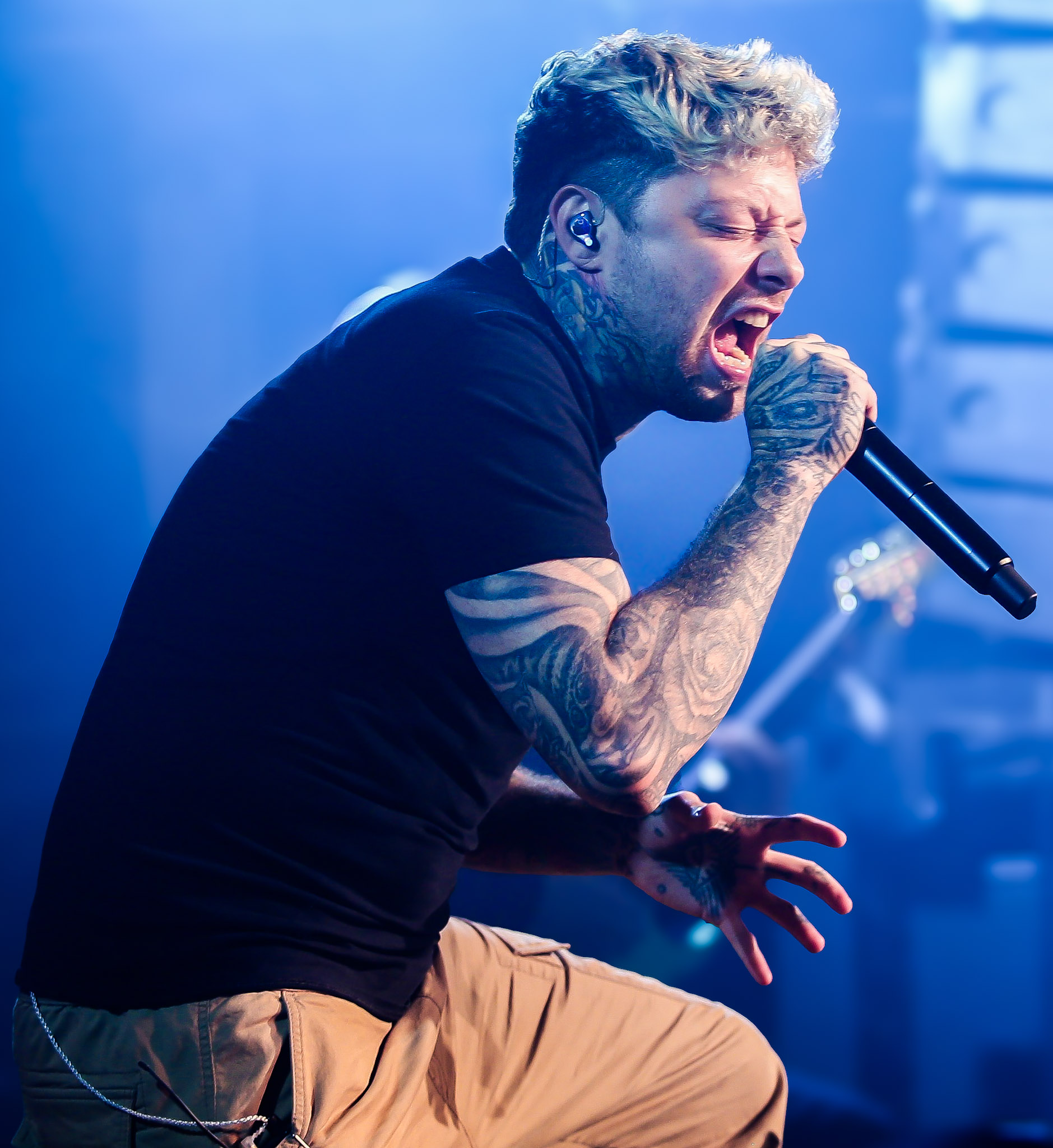
There are nights when Leeds seems to thrum with a very specific electricity, when the air itself feels preloaded with expectation, vibrating long before the first note hits. On this night, that hum for many began as they threaded themselves through the industrial outskirts toward Project House—a venue that feels like it was excavated from a quarry and then taught how to hold noise. It’s the kind of place whose walls look like they remember things: past shows, crowd surges, sweat evaporating into the rafters, the lingering ghosts of feedback and mechanical hum. Tonight this cavernous creature of concrete and steel saw hundreds of black-clad disciples ready for a four-part sermon of brutality. These weren’t casual fans, this was the congregation.
Inside, lights shook themselves awake in sharp beams slicing the room, smoke drifted like early morning fog over a battlefield and I found myself slipping through the doors just late enough to miss the beginning of Crown Magnetar’sset—only the start, the first blast of their ferocity—but enough to feel like I had walked in on a runaway train already at full tilt and by the time I crossed the threshold, Crown Magnetar had already begun their onslaught.
Formed in Colorado and rising at breakneck speed since the late 2010s, Crown Magnetar have become synonymous with tightly wound, hyper-technical Deathcore that blends surgical precision with unflinching heaviness. Their early singles built a cult following among fans who thrive on complexity, and their 2021 full-length only cemented their reputation as one of the new-school standard bearers pushing the genre into more extreme territory, and stepping into Project House mid-set, that history made immediate, visceral sense.
They were an eruption—vocals spat like molten iron, guitar work sharpened to a scalpel’s edge, and drumming so blisteringly fast it seemed to rewrite the room’s internal rhythm. The floor vibrated with every double kick. The pit tore itself into motion like an engine revving too high. Even without catching the first moments, the energy told the story: this was a band playing like they were still fighting for recognition, even as they’ve already become a name whispered reverently in heavy circles. I’d missed the start—just that first spark—but the fire was impossible to ignore, Crown Magnetar are new-school technicians ascending with terrifying speed
Then Mugshot took the stage, and the fire became something reckless. Emerging from the Bay Area’s fertile Hardcore scene in the mid-2010s, Mugshot built their reputation in cramped rooms and sweat-drenched community halls, where songs hit like blunt trauma and crowds treated shows like battleground therapy. Their sound comes from that lineage—metallic Death Metal tinged Hardcore, thick with emotion, unashamedly raw, and when they appeared under the burning lights of Project House, all that lineage came roaring to the front.
The set burst open with violent enthusiasm. Their frontman stalked the stage with an animalistic confidence, shouting with the conviction of someone who’s seen every basement scene from Oakland to Sacramento. The guitars carved out thick slabs of distortion, the drums fired like warning shots, and the crowd reacted instantly. Pits erupted and collapsed, bodies collided and reformed, strangers clung to each other’s shoulders to stay upright. Mugshot have always been a band that thrives on connection—not polite, arm’s-length connection, but the kind forged in sweat and shouting inches from someone else’s face. Here, miles from the Bay Area that spawned them, that same energy took hold, they are simply deathened Hardcore warriors born in Bay Area grit.


Then came the cold blue shift—the sonic equivalent of a door slamming. Signs Of The Swarm emerged onto the stage to a heroes welcome. Their history is the story of a band constantly evolving, rebuilding, and growing more monstrous with every release. Formed in Pittsburgh in 2014, they were originally a rising name in the early waves of slam-influenced Deathcore, but line-up changes across the years brought new textures, new depths, and new ambition. With each vocalist—from early days, through the punishing mid-era, and now with current frontman David Simonich—they didn’t just survive the shifts; they became heavier. More precise. More terrifyingly controlled. A crushing monolith reshaped again and again.
The moment they hit their first note, that history thundered through Project House like a tectonic shift. Simonich’s vocals—those impossibly low, guttural roars—rolled outward like seismic vibrations. The guitars churned with deep, grinding weight, multilayered and oppressive. Drums snapped with inhuman speed, shifting from blast beat territory into breakdowns that felt designed to collapse lungs. The crowd sank into the sound, buckling under it, moving with it, letting it swallow them whole.
If early Signs Of The Swarm was raw brutality, the modern incarnation is refined devastation—a fully grown leviathan. The pit became an ocean swallowing itself in spirals. Sweat flung off bodies in shining arcs. People screamed lyrics back, their voices cracking from the effort. Every strobe lit the band in fractured tableaus: silhouettes against smoke, contorted bodies, suspended chaos. Signs Of The Swarm are undeniably behemoths forged through evolution.


And then the final transformation of the night arrived: Chelsea Grin. A band whose history is embedded in the timeline of modern Deathcore itself. Born from the late-2000s MySpace surge in Salt Lake City, Chelsea Grin quickly became one of the cornerstones of the genre’s explosive rise—shaped by lineup shifts, sonic expansion, and a willingness to experiment. Their early EPs brought them worldwide attention; their albums throughout the 2010s cemented them as pioneers who blended technicality, melody, and relentless heaviness long before it became the norm. With Tom Barber joining in the late 2010s, they entered a new era—darker, sharper, heavier, and more confident.
When they stepped into the lights at Project House, that entire history radiated from the stage. The roar that greeted them was thunderous—fans who’d grown up with their earliest songs now standing shoulder-to-shoulder with younger devotees discovering them at their most potent.
From the first track, Barber commanded the room like a seasoned conductor of chaos. The guitars sliced through the mix with crystalline precision, carrying the icy melodic undertones that have long been the band’s signature. The drums detonated with punishing force, and breakdowns shook the room so hard it felt structural. The pit reopened in a vast, wild circle, bodies flinging themselves into motion not because of adrenaline alone, but because this band—this moment—demanded it.
Fans screamed lyrics through sweat-soaked hair. Strobes turned the band into flickering phantoms, appearing and vanishing in loops of violent light. People clung to rails, beaming, exhausted, alive.
And when the final breakdown faded, and Barber let the last growl dissolve into the ringing air, the room exhaled as one entity—steam rising from bodies into the cool lighting, everyone worn out in the best possible way. Chelsea Grin are Deathcore royalty who are still pushing boundaries more than a decade on.


Four histories converging, four chapters in the evolution of heavy music colliding under one roof and one venue left trembling in their wake.
It wasn’t just a show. It was the living timeline of deathcore, compressed into a single violent, cathartic night—captured in sweat, sound, motion, and a night Project House will keep echoing long after the bruises fade.




No Comment