
Over the last fifteen months we here at Backseat Mafia have been publishing a series of Buyers Guides on a number of musical acts. Sometimes these guides have covered a specific period in an act’s career, sometimes it has been a more general overview. There are some acts though, where an exhaustive overview can be frankly overwhelming for the newcomer, hence the start of a new series of Beginners Guides in which we help newcomers to pick their way through some of the more labyrinth back-catalogues of popular music by selecting five albums and a compilation or live album which should act as an introduction to the solo artist or band in question.
Where else to begin then than Bob Dylan, that unarguable icon of popular culture and the man who has embodied just about every aspect of what being a songwriter is since the early 60s? Over 54 years, 35 studio albums, nearly 100 compilations, 11 Volumes of his official Bootleg Series and 8 live albums, Dylan has been with us. With his most recent album, an idiosyncratic albums of covers of songs made famous by Frank Sinatra called Shadows in the Night, recently being released, there seems no better time to celebrate the career of Bob Dylan.
1) The Freewheelin’ Bob Dylan (1963)
Dylan’s early albums are a blend acoustic ballads and the type of protest folk that has found him desperately treeing to outrun the ‘voice of a generation’ tag for over half a century.
Of the albums from the first phase of his career it’s The Freewheelin’ Bob Dylan that remains the most iconic and definitive of his early works. The bare-bones production of this album that gives it an intimacy and directness which has continued to influence lo-fi music to this day. As much as his political songwriting has been celebrated down the decades, it’s actually the songs which weren’t adopted as protest tunes from The Freewheelin’ that have continued to shine undimmed, with both “Don’t Think Twice, It’s Alright” and “Talking World War III Blues” that remain the most rewarding listens.
Although he continued to mature as a songwriter during this initial acoustic folk period, The Freewheelin’ Bob Dylan stands as his definitive early work and the one you should reach for before any of the others.
2) Highway 61 Revisited (1965)
Dylan’s ‘Electric Trilogy’ is now seen as a major waymarker in the development of 20th Century popular culture, and of the trio of albums, it is Highway 61 Revisited that stands head and shoulders above the others.
With Highway 61 Revisited there was no compromise as Dylan perfected a blend of singer songwriter smarts and electric rock’n’roll energy. There’s not one track on Highway 61 Revisited which is surplus to requirements and if anything else had been added it would have spoiled the dynamic of the album.
Ask a room full of Bob Dylan fans what their three favourite songs from Highway 61 Revisited are and they will bicker for weeks, maybe even months. There’s just so much good stuff here, but the three that have always had a special place in my heart are “Tombstone Blues”, a song propelled along by some of the most exciting acoustic guitar you are likely to hear anywhere. “Ballad Of A Thin Man”, is an undisputed Bob Dylan classic and the title track, a song that get’s overlooked too often when compared to its illustrious brethren.
The album of course closes with the epic “Desolation Row”, the only ‘acoustic’ number on Highway 61 Revisited , but at least it’s a cracker, one of the few songs that can totally justify having more than ten minutes spent listening to it.
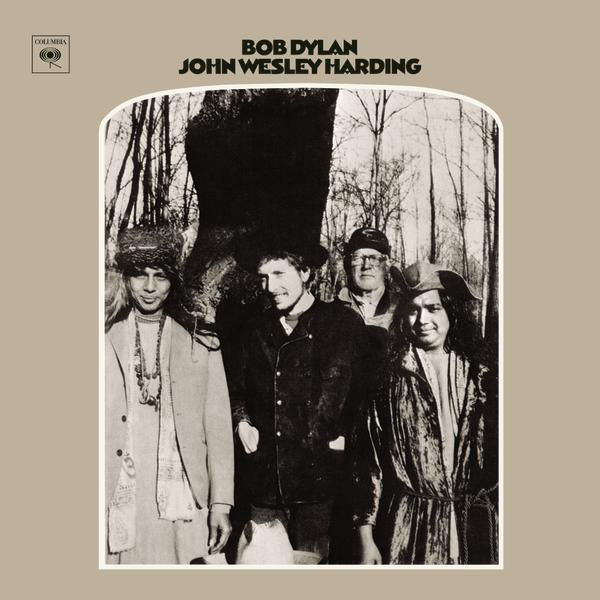
3) John Wesley Harding (1967)
The Electric Trilogy didn’t just solidify Dylan as an icon of popular song and the rapidly expanding counterculture, but it made him a commodity. Microphones were stuck in front of him whoever he went, in expectation of the next quotable soundbite to slip from his lips. He was over-worked, over-booked and dangerously close to becoming utterly burnt out.
Then came the motorcycle crash which allowed Dylan to slip away from the public eye for nearly eighteen months from July 1966 to late 1967.
When Dylan returned, it was with the album John Wesley Harding, a sound which found him partially returning to his acoustic roots, but instead of reprising the protest of his early material, he went all country-rock and used all manner of religious imagery in his songwriting. Okay so maybe it wasn’t the album that his fans were expecting, but it was an album that Dylan needed to make in order to prevent himself from burning out. It’s not the most immediate album, but given a few plays it starts to show real substance and depth.
Something of a quiet wonder, John Wesley Harding has not been subsequently encumbered with the heavyweight reputation that many of Dylan’s albums labour under. It also gave notice that Dylan didn’t feel the need to be permanently at the bleeding edge of popular song, and that sometimes being laid-back could be as productive as pushing the creative envelope, pointing the way towards roots rock trail that his former live backing band would blaze as the Band when they released Music from Big Pink eighteen months later.
All this and the original (and best) version of “All Along the Watchtower”.
4) Blood on the Tracks (1975)
Such has been the reputation of the ‘Electric Trilogy’, it has almost eclipsed the result of Dylan’s output, even the political folk period which made his name. It’s reputation casts a long shadow over every other album he has released during his longer his career.
Except one.
Blood on the Tracks.
An album of jaw-dropping romance, heart-break and naked emotional honesty, Blood on the Tracks is a strong contender for the greatest musical statement of all time. It has the power to simultaneously lift spirits and cause us to break down in tears and as we make our way through life and experience what the world has to offer, it travels with us ageless and utterly dependable.
Of all Dylan’s work, Blood on the Tracks contains the highest concentration of his songs that we can relate to. We may not have experienced everything that Dylan sings about here, but we can relate to it and compare it to our own experiences in such a way that it effects us in a manner that few albums do. That’s certainly why I love Blood On The Tracks, as I’m able to superimpose my own experiences over the music and lyrics and it’s a damn near perfect fit. Not only is it Dylan’s relationship album, but it’s so many other people’s as well. With Blood On The Tracks there’s a song for every rush of romance, gasp of lust, inevitable heartbreak and corkscrew to the heart.
5) Oh Mercy (1989)
The majority of Dylan’s 80s albums are frustrating, as there were moments of genuine genius either buried on terrible album, submerged on B-sides or not even released at the time. He struggled to juggle 80s production values, quality control and generally being Bob Dylan until membership of The Travelling Wilbury’s which seemingly reminded him that the creative process could be a genuinely enjoyable thing.
His next solo album, 1989’s Oh Mercy, Dylan finally officially released some of his best work of the decade. Sure, not many would hold it up as vital when compared to his mid-60s work or Blood on the Tracks, but it served notice that he hadn’t completely lost his creative marbles. “Everything Is Broken”, “What Good Am I?” and “Shooting Star” are more substantial than almost else he had produced in the last decade, but it’s “Man In The Long Black Coat” and the stunning “Most Of The Time” show that he could still match his creative peaks when he stayed focused enough.
Admittedly much of the success of Oh Mercy was down to Daniel Lanois’ quite brilliant production job, which gave Oh Mercy its special ambiance which managed to convert a fair-to-middling song like “Disease Of Conceit” from merely passable to reasonably interesting.
6) Dylan (2007)
Given Bob Dylan’s status as one of the pre-eminent musical icons of pop culture, it is perhaps inevitable that there have been a mind-boggling number of attempts to distill his appeal within a compilation. Some of these compilations have become iconic in their own right, with 1967’s Greatest Hits being a masterclass of single disc compilation, 1985’s Biograph setting the standard for boxed sets to come, and The Bootleg Series Volumes 1-3: (Rare & Unreleased) 1961-1991 which not only laid the groundwork for a series of releases which has effectively become the alternative history of Dylan’s musical career, but pretty much led to the music industry’s ongoing obsession with archive releases.
For the beginners though it is 2007’s lavish triple disc Dylan that is the wisest investment for the newcomer to the World of Bob. Over three discs, 51 tracks cover every period of his career, representing almost every studio album, with the exception of Self Portrait, Dylan and and Saved. As a result even his dodgier 80s albums and his frankly awful early 90s covers albums are acknowledged, as well as the career rejuvenation he has enjoyed since the late 90s. The triple disc version of this release (which also came in watered-down single and double disc issues) also boasts some pretty vinyl-replica packaging, a swish red case, a relatively informative booklet and a stack of postcards.
There are of course, many, many more Bob Dylan albums to explore, many of which are excellent (Blonde on Blonde and Planet Waves are both particularly worthy of investigation), but some of which should be approached with caution. None should be approached with more trepidation than 1973’s Dylan, a selection of cast-offs and off-cuts released by his former record label, seemingly as an act of petty revenge for signing elsewhere. It is frankly awful and has been disowned by the man himself on more than one occasion.


