By Mimi Nicholson
Bishopskin’s debut album Babble is almost liturgical, with its invocation of religious life and many
repeated motifs. Rooted sonically in the traditions of folk-revival and London’s post-punk music scene,
its thematic wellspring includes Romanticism, medieval mysticism and the Christian Bible. This
eclecticism carries into the band’s aesthetic; unlike the sleek sexiness you might find in performances
from their leading contemporaries, such as HMLTD and Opus Kink, Bishopskin’s line-up is more
redolent of Ian Dury’s shambolic Kilburn and the Highroads, yet it is precisely this haphazard vitality that
makes their shows so very compelling.
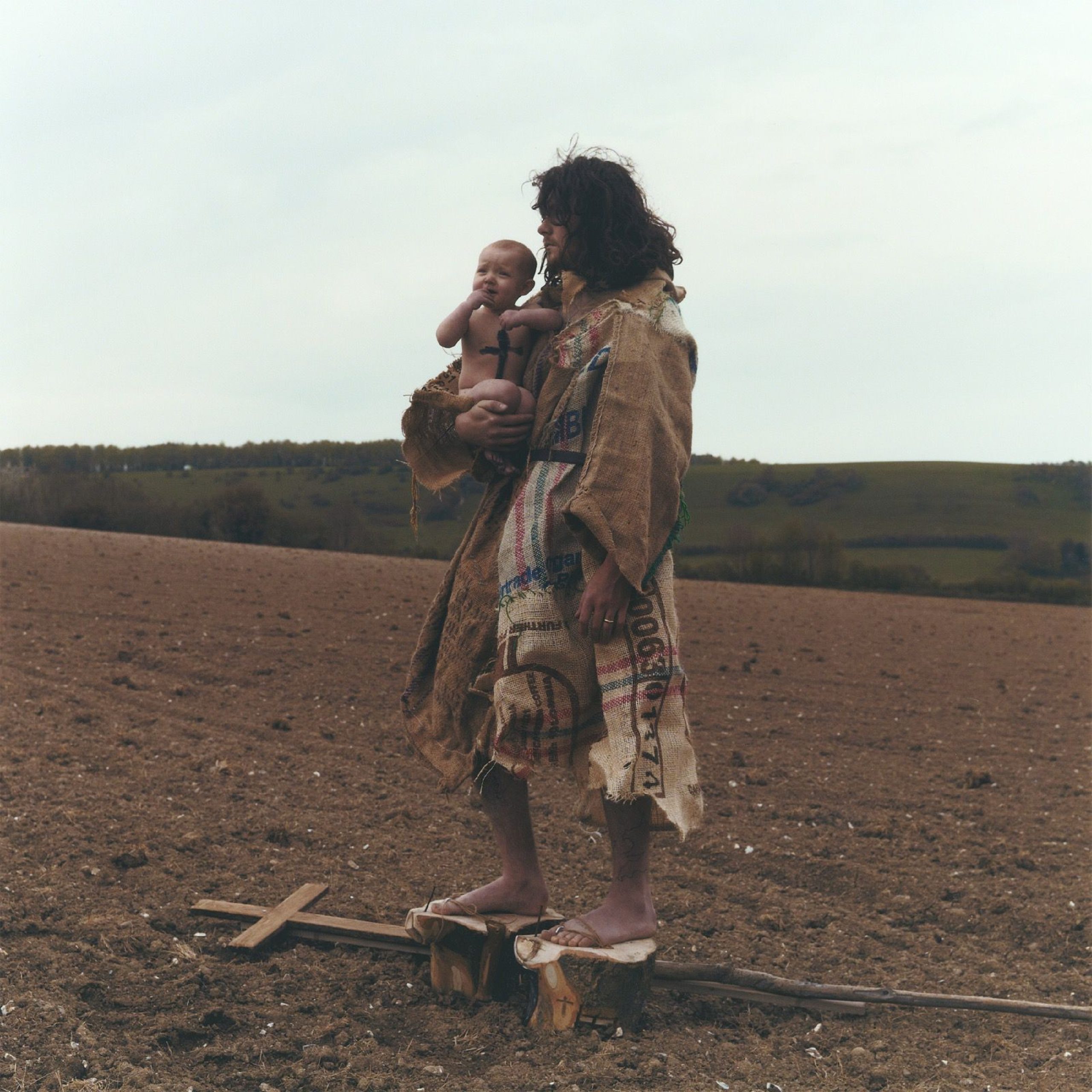
The album’s cover artwork depicts frontman Tiger Nicholson as a prophet; a strange combination of the
wild asceticism of John the Baptist complicated by the worldly commitment of fatherhood. The image
suggests both penitence and hope – the baby (Tiger’s own), a symbol of innocence, is nevertheless marked with the cross of Ash Wednesday, a ritual that begins a repentant period of sacrifice. Yet the ploughed and ready land and fertile hills of the backdrop – along with Tiger’s forward-looking gaze – suggest newness, and mission.
It opens in the dark and brooding space of Ave Maria, the narration of despair and near-suicide resulting
from a fruitless journey of religious devotion. Here, as elsewhere, Tiger uses language much like an
abstract expressionist would paint, freely and gesturally, playing – much in the vein of Manley-Hopkins –
with onomatopoeia and pure sound. This is especially the case in the song’s introduction, but the message
soon becomes abundantly clear: salvation. The singer’s salvific vision of the Virgin Mother seems
refreshingly far away from the pallid skin, blue veil and downward gaze of much iconography. Conversion
here is not airbrushed; it is scary and dangerous, yet holy – and the holiness is unmissable in the ethereal,
tongues-like solo of Tabitha Avanzato. Yet, despite the experimentality of the introductory and solo
vocals, Ave Maria remains a punchy pop song. The hook of the chorus’s “A-A-A-Ave Maria” is
emboldened by Hana Miyagi’s genius violin riff, which accentuates its simple form like the thick black
lines on an Egon Schiele figure.
The next track, Mother’s Steel Bike, is a prime example of one of the work’s driving themes: anamnesis.
Opening with the frank line “When I was a boy”, the song quickly transforms into an unexpectedly
electronic sound suggestive of Cosmo Sheldrake. It seems to grope, urgently, at a memory – as though
Tiger’s childhood vision of the “man with holes in his hands” may somehow be purer than his adult
conception of Christ. The lyrics, “sing your prayers to the wind on your mother’s steel bike,” gain an additional charm when you know that this memory – of a child singing out from the front bars of his
mother’s bicycle – is in fact a genuine one from Tiger’s boyhood. Tati Gutteridge’s chorus juxtaposes the
straight narration and dialogue of Tiger’s verses with an eerie yet beautiful vocal composition of abstracted sounds and the enigmatic line “cucura, cucura clip my wings”, which reads as a cry for guidance in a “wicked” and complex world.
My criticism would lie most heavily with the song that follows shortly after, Hey Little Sister. Although
offering exciting moments of instrumentality, especially on behalf of Harmonica player Rob McCann and
bassist Matthew Baker, the song’s structure feels slightly weak. It may be my own close-mindedness, but
the distinctively noughties pop vocal gesture that marks the opening of the chorus – “I-ee-ey-ee-I’ve got
mud on my knees…” – seems jarring and noticeably lacks the originality of other songs.
The following track, Come Home, is brave and hypnotic – the stripped-back percussion and daringly
eclectic instrumental and vocal sections work to make an understated yet tantalising song. But it deserves
mention most pressingly for James Donovan’s guitar performance, which in this track, as well as Larks
Prayer, reveals just how skilful he is with his instrument. The twangy loop-riffs that you find in both these
songs are characteristically James, and require laudable dexterity and inventiveness to write and deliver.
He sits much more humbly throughout than frontman Tiger, but it is his musical aptitude that allows any
of Tiger’s fledgling intuitions to be realised. Larks Prayer is also worth flagging for its inspired use of
gospelesque keys in the minimalist style of Leif Vollebekk, played by pianist Adam Brown.
Sitting bang in the centre of the album is its apogee, Born, which keen fans will recognise is a sequel to
the looped and emotional I Was Born on an Island, released previously as a single. The relevance of the
lyrics “Oh, I was born on an Island,” remains ambiguous; are they lamenting the isolation and selfishness
of human life, or are they a simple and inexplicable cry to Tiger’s homeland, England? Either way, it
moves suddenly from these familiar lyrics and melody to Gethsemane, the garden where Christ spent his
last moments before arrest and torture. The instrumentality that just precedes Tiger’s opening dialogue,
“Oh dear Father how I wish to be there on that night,” seems to capture the speed of the fleeting, flying
robe of the naked fugitive who flees the site of arrest in the Gospel of Mark. The terrible fear of the scene
is held in the drumbeat and the sincerity of Tiger’s voice. Yet the lyrics make it manifest that this is fantasy, not reality. And in this world of fantasy the song can move freely to another of the Bible’s most poignant scenes: the burning bush. The pairing of these scenes is bold. It highlights the central paradox and unfathomability of Christian faith: that the broken Christ crying to his Father “take this cup from me” is the very same God as Moses encounters in the burning bush.
It is also at this point that the prophetic character of the album becomes most explicit. Here Tiger
proclaims himself as Moses, not shying away from revealing God’s own call to him: “evangelise the
nation”. The song’s climax is therefore the climax of the album as a whole. It recounts a personalised
encounter with God in the burning bush: “I said, ‘I am dumb, this tongue won’t last very long.’ And He
said, ‘Am I not the one who made thou dumb tongue?’ And I replied, ‘Who-ooh-ooh, who art thou?’
And He said, ‘I, I, I, I AM WHO I AM’”. The musicality of this section is phenomenal and shiver-
inducing. The rhythm of the vocal and guitar delivery is initially punctuated and emphatically direct, but it manages to fall seamlessly into an almost kitsch, cathartic harmony, in which we get to hear a rare vocal
contribution from the band’s most versatile member – James Moss. Shirking away from the idealised
vision of being there on the treacherous night of the crucifixion, the singer’s response to the reality of
being face to face with God is one of fear and doubt. Yet despite these wavering and trepidatious lyrics,
the music suggests that he does indeed rise to the challenge, spurred on by Hana’s violin, and testified to
by this album’s very existence.
This hefty number is followed by an additionally energetic Stella Splendens, a reworked 14th century Latin
hymn, brainchild of Tati. It would be apt in a movie bar-fight scene with its aggressive vocals and rhythm
(one of the only recorded tracks played by current drummer Alex Prete). It touches on the hysterical
force that popular piety can garner. Laced with shrieks, bellows and folk fiddle, it is potent and galvanising.
This track is then immediately followed by Holy Mary, a song in which Tabitha takes centre stage. Unlike
the cinematic immediacy of Stella, one hears the introduction of Holy Mary and feels almost as if they had encountered it in a meadow in passing; the vocals are distant, mesmerising and mantra-like. Tabitha’s
delivery has a distinct indie Englishness about it, especially compared to the soulful, bluesy solos of songs
like Hey Little Sister.
When Tiger’s almost horrifyingly direct lyrics “I’m in love… with…” come in about halfway through, one
is relieved instantly by the following words, which redirect this hackneyed phrase to the natural beauty of
“the golden hills, the rolling leaves, the cluttered heart, the thinking trees”, delivered with a simple and
moving melody which complements the words’ natural rhythm. As with many of the album’s songs, the
spiritual vision of St. Francis of Assisi permeates – divine love mediated through the natural beauty of
one’s own landscape. And whereas Stella gave us the euphoric folk mayhem of communal joy, Holy Mary
offers us an alternative, of community formed in quiet love and the simple awareness of our individual
frailty: “Holy Mary Mother of God, the English Queen, the Isle of Dogs, dancing to this melody, hand in
hand in heresy”. It is beautiful because it is a song that captures the sheer grace of redemption, and the
joy that it brings despite our brokenness and error.
Closing the album is the lullaby Jerusalem, delivered solely by Tiger, concentratedly and sincerely
fumbling at a piano he can hardly play (the only addition being the gurgles of the cover’s infant making a
final appearance, this time, however, recontextualised – we could even say redeemed – in light of the epic
journey of the album). It is striking how the solitude of this song mirrors and juxtaposes the solitude of
the opening. Whilst Ave Maria depicts restless despair this closing track is heavy with peace. It is imbued
with redemption, and a humble plea from the album’s faithful protagonist, who appears, finally, serene –
enlightened by its pilgrimage.
Check out the bands track Ave Maria, below:
Find out more via the bands Facebook
Purchase the album here