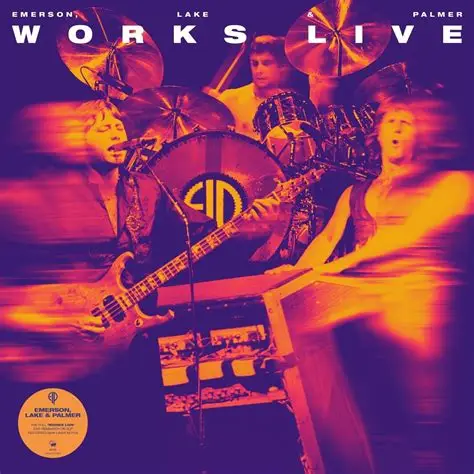
For decades, ‘Works Live’ has occupied one of the most misunderstood positions in Emerson, Lake & Palmer’s extensive catalogue. Overshadowed by the commercial success of ‘Welcome Back My Friends to the Show That Never Ends’ and burdened by the complicated history surrounding its original release, it has often been regarded as something of a curiosity rather than an essential live document. Yet those willing to spend time with it have long recognised its significance. It captures one of the most ambitious periods in ELP’s career, when the trio attempted to merge progressive rock, classical music and arena spectacle on a scale that few bands would ever dare to contemplate. The 2026 remastered edition not only reaffirms that ambition but presents the album in the best sound quality it has ever enjoyed, making a compelling case for its re-evaluation as one of the band’s finest live releases.
The album’s history is almost as fascinating as the music itself. Recorded during the 1977 North American ‘Works Volume I’ tour, many performances featured a full orchestra accompanying the trio, fulfilling Keith Emerson’s long-held dream of bringing his classical compositions to the concert stage with the scale they deserved. Financial realities ultimately curtailed the orchestral aspect of the tour, making these recordings an invaluable document of a remarkably bold experiment. The material first appeared in abbreviated form as ‘In Concert’ in 1979, a release that frustrated both the band and fans because significant portions had been removed. It was not until the expanded ‘Works Live’ edition restored Emerson’s preferred running order that listeners could appreciate the project as originally intended. Nearly three decades later, this 2026 remaster offers the clearest and most balanced presentation yet.
From the opening moments it becomes obvious that considerable care has been taken with the mastering. Rather than chasing excessive loudness or modern compression, the engineers have concentrated on revealing detail that has always existed within the recordings but was previously obscured. The result is a soundstage that feels wider, deeper and considerably more natural. Every instrument occupies its own space while preserving the excitement and occasional unpredictability of a genuine live performance.
Keith Emerson is perhaps the greatest beneficiary of the remaster. His Hammond organ roars with newfound authority, the Moog synthesiser possesses remarkable texture and warmth, and his grand piano performances sparkle with clarity. Emerson’s playing has always balanced astonishing technical precision with an almost reckless sense of adventure, and the improved definition allows listeners to appreciate the countless improvisational details that often became buried in previous editions. Fast keyboard runs emerge with greater articulation, while quieter passages display subtle dynamic shading that reminds us just how expressive his touch could be.
Greg Lake’s contributions also receive a noticeable lift. His bass guitar, frequently overlooked because of Emerson’s flamboyant keyboard work, sounds rich and full-bodied throughout. More importantly, his vocals possess an emotional warmth that earlier releases sometimes failed to capture. Songs such as ‘C’est La Vie’ and ‘Watching Over You’ provide welcome moments of intimacy amid the grand orchestral arrangements, with Lake delivering performances that are both heartfelt and technically assured. His ability to move effortlessly between delicate acoustic balladry and commanding rock vocals remains one of ELP’s defining strengths.
Carl Palmer’s drumming has arguably never sounded better on this album. Every tom fill, cymbal flourish and snare crack cuts through with impressive precision, yet the performance retains its natural ambience rather than feeling artificially enhanced. Palmer’s extraordinary stamina and technical brilliance are on full display, particularly during the instrumental sections where he drives the music forward without ever overwhelming his bandmates. The rhythmic interplay between Palmer and Lake provides the solid foundation that allows Emerson complete freedom to explore increasingly adventurous musical territory.
One of the greatest achievements of this remaster is its treatment of the orchestra. Live recordings from the late 1970s involving full orchestras often struggle with balance, frequently reducing the classical musicians to little more than background decoration. Here, the orchestral arrangements possess genuine weight and presence while remaining integrated with the trio. Strings, brass and woodwinds can be heard contributing meaningful colours to the performances rather than simply adding volume. The engineering successfully captures both the grandeur of the arrangements and the spontaneity of a rock concert, no small accomplishment given the technical challenges involved.
Among the highlights, ‘Fanfare for the Common Man’ remains an absolute showstopper. Aaron Copland’s familiar theme gradually builds into one of progressive rock’s most exhilarating live performances, driven by Palmer’s relentless groove and Emerson’s dazzling synthesiser improvisations. The remaster enhances the sheer physical impact of the piece without sacrificing its spaciousness, allowing the famous Moog lines to soar above the rhythm section with remarkable clarity. It remains one of ELP’s definitive live statements and a thrilling demonstration of the band’s ability to transform classical-inspired material into arena-sized rock theatre.
‘Knife-Edge’ provides an altogether different kind of excitement. Aggressive, muscular and unapologetically theatrical, it captures the trio operating with tremendous confidence and energy. Emerson attacks the Hammond with ferocious intensity, Palmer propels the performance at breathtaking speed, and Lake’s commanding vocal anchors the controlled chaos. The improved separation enables listeners to follow the intricate musical conversations taking place between all three musicians, highlighting just how tightly rehearsed yet instinctively responsive the band remained.
The second half of the album offers equally rewarding moments. Excerpts from ‘Pictures at an Exhibition’ continue to demonstrate why ELP’s adaptation of Mussorgsky became one of progressive rock’s defining reinterpretations. The transitions between delicate piano passages and explosive full-band climaxes possess greater dramatic contrast than ever before. ‘The Great Gates of Kiev’ benefits especially from the expanded dynamic range, allowing the performance to build naturally towards its triumphant conclusion without sounding congested.
Keith Emerson’s own ‘Piano Concerto – Third Movement’ also emerges as a revelation. Previously, portions of the orchestral accompaniment could seem slightly veiled, but the remaster reveals far greater detail within the arrangement. Listeners can better appreciate the dialogue between Emerson’s virtuosic piano playing and the orchestra, reinforcing the seriousness with which he approached his classical compositions. Whether one considers it progressive rock, contemporary classical music or something entirely unique, the performance reflects Emerson’s fearless refusal to accept musical boundaries.
If there is one unavoidable limitation, it lies not with the remaster but with the source material itself. ‘Works Live’ remains a compilation assembled from multiple performances rather than a complete concert preserved from beginning to end. Some transitions inevitably feel less cohesive than a fully documented show, while occasional imperfections in the original live recordings remain audible. Yet these are historical realities rather than production flaws, and the remaster wisely preserves the authenticity of the performances instead of attempting to disguise them through excessive digital processing.
The accompanying booklet provides valuable historical context, documenting both the enormous ambition of the Works tour and the logistical challenges that ultimately made the orchestral format financially unsustainable. Looking back nearly fifty years later, it is remarkable that ELP attempted such a project at all. Few bands possessed the confidence—or perhaps the audacity—to tour arenas with a full orchestra while performing music that demanded both technical virtuosity and complete concentration from every participant.
Perhaps the greatest compliment that can be paid to this new edition is that it encourages listeners to reassess the album entirely. Rather than existing merely as a historical curiosity or companion piece to other live releases, ‘Works Live’ emerges as a vital snapshot of Emerson, Lake & Palmer at the height of their creative ambition. It captures three exceptional musicians pushing themselves beyond conventional expectations, determined to prove that rock music could stand comfortably alongside classical performance without compromising the excitement of either tradition.
The 2026 remaster succeeds because it understands that great archival releases should illuminate rather than reinvent. Instead of modernising the sound or smoothing away every rough edge, it simply reveals the performances with greater fidelity, allowing their strengths to speak for themselves. The result is a listening experience that feels both fresh and faithful, offering longtime fans a compelling reason to revisit a frequently overlooked masterpiece while providing newcomers with perhaps the finest introduction to one of progressive rock’s most audacious live achievements.
Nearly half a century after these concerts were recorded, ‘Works Live’ remains a monument to musical ambition on a scale few artists have attempted before or since. This beautifully judged remaster finally gives the album the sonic presentation it has always deserved, reaffirming its place not only within Emerson, Lake & Palmer’s catalogue but among the defining live recordings of the progressive rock era.