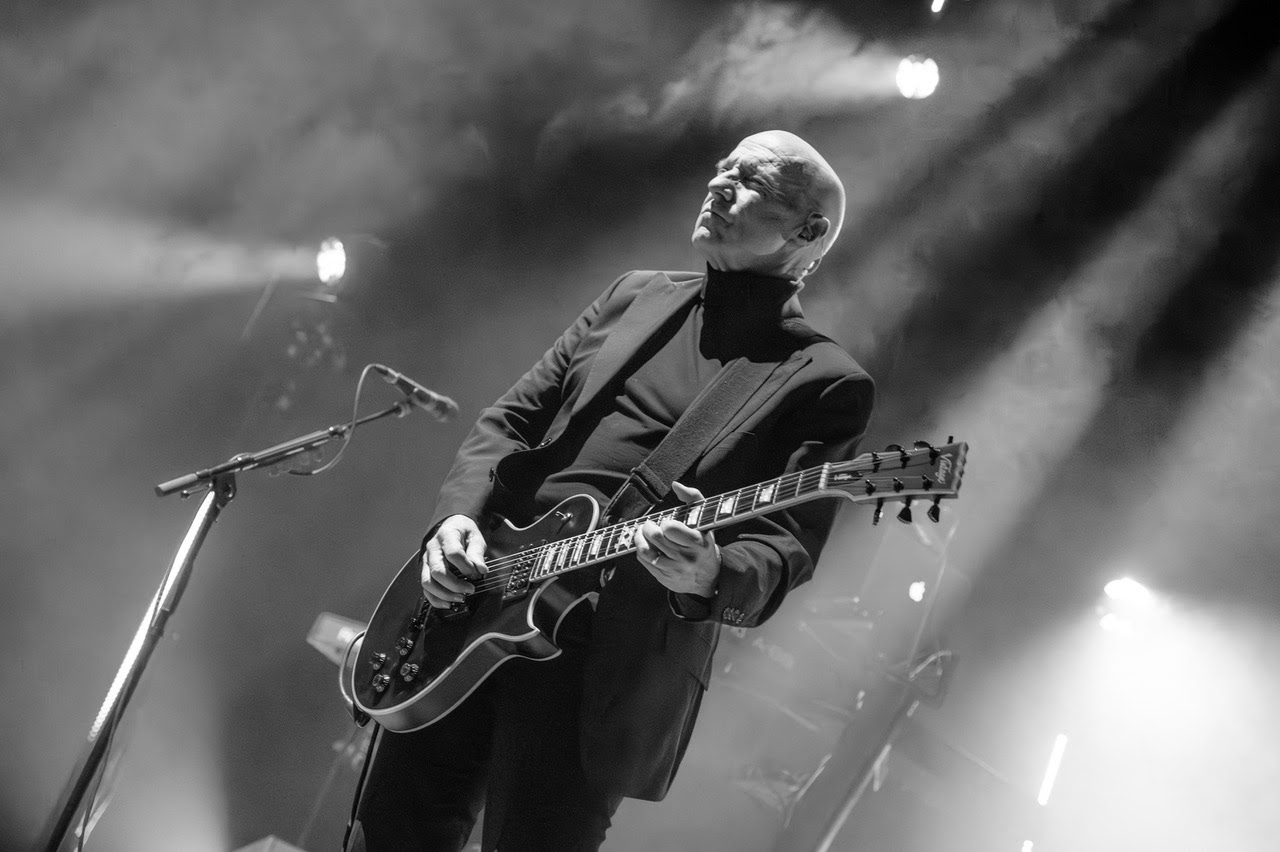
Ahead of his rescheduled Australian tour on the Catalogue: The Hits tour, the Ultravox frontman talks with me about Joe Dolce, Scottish tenacity, and why he refuses to sulk through Vienna.
The last time I saw Midge Ure on stage was with Ultravox at Sydney’s Capitol Theatre, around 1982. He remembers it only as a happy blur.
I was just too excited being in a successful band and being in Australia. How lovely was that?
Australia has not always been so kind to him. In early 1981, ‘Vienna’ was one of the most unlikely hits British radio had ever played: a brooding, atmospheric piece with a viola solo and a video that looked like a lost Carol Reed film. It stalled at number two. First it sat behind John Lennon, who had just been shot. Then it sat behind Joe Dolce’s ‘Shaddap You Face,’ a novelty single by an Australian-based artist.
So I had to ask whether he holds a grudge against the country.
I have no gripes with Australia at all, I think the rest of the UK probably has. (laughs)
For Ure, the chart position was never the point.
The four guys in Ultravox were just ecstatic to have something so obscure and different and individual at the number two spot. An artist’s job finishes when you write the song and record the record, and then you hand it across to the machine, and it does whatever it does.
He concedes that the icing on the cake would have been, of course, had it gotten to number one.
The Dolce single, he says, is something no one can explain. If you were writing a Black Mirror-style comedy where everything had to be ironic and ridiculous, that would be a tough one to try and beat.
The story of how Ure came to sing ‘Vienna’ is almost as unlikely as its success. He bought a synthesiser in 1978, after his former the Rich Kids had run their course, and soon found himself DJing in a small London club with Rusty Egan, the band’s drummer. The club was a forerunner of the Blitz. They played Kraftwerk, La Düsseldorf and other European music you never heard on UK radio, cut with tracks from Ultravox’s then-current album, ‘Systems of Romance’.
It sounded phenomenal in a DJ booth, on a sound system
That scene grew into Visage, with Steve Strange, Egan, members of Magazine and Ultravox keyboardist Billy Currie. Ultravox itself came home from an American tour as a broken band. John Foxx had left, guitarist Robin Simon had gone, and the label had dropped them. It was Egan who told Currie that Ure was the man they needed.
I was too shy to ask.I found myself joining a band that nobody wanted. And the moment we plugged in and played, it was the most magnificent thing I’d ever heard in my life. This all-powerful, atmospheric, anthemic rock thing.
He never imagined it would sell.
The world was telling us it was time for the band to go away. But I wasn’t hearing that or seeing that. I saw something that was just exciting.
On the Vienna album he was still finding his place. Drummer Warren Cann wrote many of the lyrics, and Ure was very much learning from these guys rather than pushing anyone out of the way. But the title track felt different from the start.
It was no holds barred. It went against everything that was going on at the time. It didn’t fit any format, it didn’t fit any genre. The record label didn’t know what to do with it, and it was great. You weren’t trying to make three-minute hit singles. You were trying to make music.
It was what he had been chasing through what he calls his weird meandering way through his career: a vehicle where he could say, let me try this weird guitar solo, let me try this idea. The whole album took three weeks. At the end of each night, waiting for cabs back to their little flats, the band would put ‘Vienna’ on and just listen.
We’d think, wow, where did that come from?
Scotland has given the world a huge share of great music, from The Jesus and Mary Chain, Simple Minds to Belle and Sebastian. Ure puts it down to character.
There’s a feistiness about the people. If it wasn’t the music industry, it’d be sport. If it wasn’t sport, it’d be engineering. We’re a creative bunch.
For a country of nearly six million, he says, Scotland punches above its weight in medicine and technology too. But music is where it shows most.
If you took all the Scots out of the music industry, it would fall apart. Not just on stage. The crews, the guys who make the structure actually work and hold it all together, tend to be Scottish.
He traces that tenacity to Scotland’s place as England’s perceived underdog, a little chip on the shoulder that you’re born with that gives you licence to push harder. Class matters too. Scotland, he says, had its fair share of slums for aspiring young artists to try and eke their way out of. He cynically laughs and agrees when I suggest the idea that music now belongs to the privileged.
I still think the best songs, the best stories, the best life interpretations that come out as music tend to come from the working classes. From people against all odds, who stick with it and push that little bit harder. I don’t think that’s changed too much.
Ask him for recommendations on any new Scottish bands and he shrugs. Without a label or a record that will bother the charts, he admits he couldn’t tell you what’s number one in the UK right now. He’s made his peace with that.
These days, people find you. You put something out, it’s not going to chart instantly, but you know that eventually it will fall on the right ears.
His old favourite is the Sensational Alex Harvey Band. Back when Scotland had a musical Hadrian’s Wall that kept bands from going south of the border, his own group worked the same circuit and venues as Tear Gas, the heavy rock band that became Harvey’s backbone. They played the dance halls but refused to play current hits, offering their own weird interpretations of classic songs instead. Ure compares them to AC/DC on the Radio Clyde roadshows: heavy, uncompromising, and unwilling to dilute what they did to get ahead. They were a big influence.
Australia has waited a long time for this tour. On his last Australian tour, everything shut down for COVID. We got to Perth to play the last show, and no one else did. We never finished that tour. Then a health scare forced him to cancel last year’s return.
I don’t cancel things lightly. If you’ve got an expensive car and the engine starts to rattle, you don’t say, I’ll leave it for a couple of months and see how it goes. You do something about it. He has been back playing live for six months now. Back up and running, engine sorted, and looking forward to coming back.
The tour’s title, Catalogue: The Hits, is a promise he means to keep. He has a theory that at any gig, half the audience has been brought along by a partner, and those people know only the hits.
It’d be grossly unfair for me to be the sulking artist and come on and say, I’m not playing Vienna tonight, I’m not playing Dancing with Tears in My Eyes, I’m not doing If I Was.
The old favourites are de rigueur. The trick is not to paint by numbers: he changes how he performs them to keep the songs fresh, and cherry-picks album tracks people probably haven’t heard in a while.
Going back through the catalogue is strange for him, though. He never revisits old albums except to plan a tour like this.
Some of it’s alien. I’m a very different person from the person who wrote and sang those songs. It feels like I’m singing someone else’s stuff. I sometimes wonder really, what were you thinking?
Much of it is a product of its time, he says, but a lot of it still stands up.
His band includes drummer Russell Field, who has played with him for 25 to 30 years. The other two members are multi-instrumentalists and a band in their own right (India Electric Co.). Ure met them seven or eight years ago, when he let local acts open his acoustic shows.
Every time these guys did it, I could hear from the other side of the curtain what sounded like a band. It was just the two of them, swapping between fiddle, keyboards, mandolins and guitars. I bludgeoned them and said, right, I want you to come and play in my band. Have you ever used a synthesiser? They jumped at it. Keyboard player Joe has a degree in advanced mathematics from Cambridge, but music is his great love. He jumps from beautiful piano to the most amazing violin solos, so I can cover a huge amount of stuff with these guys.
Ure’s most recent album, ‘Man of Two Worlds’, takes its title from an Ultravox song and pairs a record of songs with a record of instrumentals. He wrote and recorded both over the same stretch, starting in lockdown after the band finally got home from Perth. Until the last minute he saw them as two separate things. Then he played them to a musician and producer friend, who told him not to be stupid.
They’ve got the same feel, they’ve got the same atmosphere, they’ve been created at the same time. They belong together, sister and brother.
He had released instrumentals before, but never a complete body of them, and never a double album.
That really excited me, the idea of putting these together and showing the two sides of what goes on inside my head, the song side and the instrumental side.
He’s pleased the instrumentals have drawn as much praise as the songs.
When I offer one of my favourite phrases, that creativity does not have a use-by date, he takes it straight up.
It’s true. We’re part of an industry that likes to throw the baby out with the bathwater. You’ve had your 15 minutes, it’s time for you to leave now and drive a bus. It doesn’t work that way.
Then there’s the legacy: Ultravox, Visage, Thin Lizzy, and above all Band Aid and Live Aid. At the time, he says, it was the old adage:
You can’t see the wood for the trees. We were right in the thick of it all.
It hits home later, through letters from people and emails from organisations that have benefited from 40 years of fundraising.
One card stays with him. It came years ago from a company inspired by Band Aid and Live Aid, which had sponsored a girl in Ethiopia. Inside was a photograph of her at her graduation. The message said he had never met her and probably never would, but thanks to what they had done, she had just gone to university.
All the pain of doing it, the endless hours of sitting around office tables in borrowed and stolen offices, all of that was worth it. That’s what we were doing it for.
As we wrap up, I tell him I’ll be shooting from the pit in Hobart. I’ll look out for you. I’ll look out for the man in the suit. I suspect I’ll be a bit more casual.
Midge Ure plays across Australia in October – dates below and tickets available here through Destroy All Lines.

Feature Photograph: Andy Siddens