
“It’s still the same four dudes. It’s still a family.”
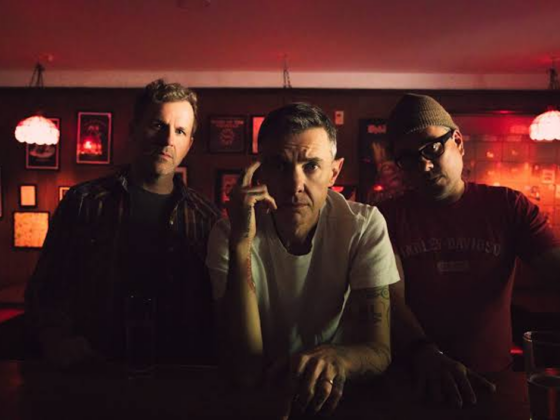
25 years on from the release of their debut album, American Hi-Fi are still driven by a genuine love of making music together. I caught up with frontman Stacy Jones ahead of their upcoming UK dates with Bowling For Soup and Frank Turner.
As soon as he hits the screen on our Zoom call, he’s warm, self-deprecating and energised by what’s ahead of the band this summer, particularly the chance to hit places the band have never played before.
“We’ve done pretty extensive touring in the UK,” he says, “but on this run there are a bunch of cities I don’t think we’ve ever been to. So very much looking forward to that.”
That excitement runs through the entire conversation. For Jones, American Hi-Fi isn’t confined to a point in time, nor is there a sense of nostalgia. It’s very much a living entity, still coming together creatively and evolving over the 25 years they’ve been together. It’s all rooted in the chemistry between the four founder members.
“It feels the same, you know? That’s the thing that’s crazy. It’s still the same guys. American Hi-Fi is still the same four guys.”
That consistency clearly matters to him. Even with side projects and life occasionally forcing adjustments (“our drummer plays in Everclear now” and “our bass player had back surgery”) the core dynamic remains intact.
“There are times when we have to sort of pivot a little bit,” he says, “but generally speaking it’s still the same four dudes. It’s still a family. We’re like brothers. And so when we get together it feels really like riding a bike. It just comes very natural.”
Jones is an engaging man and laughs often throughout the interview, but there’s a sincerity underneath everything he says about the band. When the conversation turns to live performance, he feels the group may actually be stronger now than they’ve ever been.
“I think we’ve always been a pretty good live band,” he says, “and I honestly feel like we might even be better now than we were back in the day.”
A lot of that comes from experience. “We all still do music for a living,” he explains. “I started playing in my first bands when I was 14 years old, and now I’m 55. So if I can’t pull some shit off at this point, something’s wrong!!”
That time on the road has created an almost unspoken understanding between the band members, something Jones describes in near telepathic terms.
“We definitely have that, like no question,” he says. “Just a glance or a gesture, and you just know where the guys are, where we’re going to go with it.”
It’s a level of connection he’s careful not to take for granted, much like the continued life of songs like “Flavor of the Week”.
“People still are discovering ‘Flavor of the Week’, which I think is incredible,” he says. “I never thought that when I wrote that song that it would have this life that it’s had.”
The way he talks about songwriting is perhaps the most revealing part of the conversation. Rather than presenting creativity as something carefully engineered, Jones now comes at his creative process with instinct and authenticity, reinforced through his involvement with artists across completely different genres.
“The thing that I have learned about myself and also via working with other artists,” he says, “whether it’s Miley or Olivia, I’ve been working with an artist called sombr recently…They are always the most authentic versions of themselves. I feel like for years I tried to chase something rather than just be authentic.”
That authenticity is exactly what he believes people connect with. To illustrate the point, he goes back to writing “Flavor of the Week”.
“I wrote that song in 20 minutes,” he tells me. “It was one of those lightning bolt moments. I was like, ‘Oh, I have this idea.’ I sat down, I wrote the song. I have the notebook still that I wrote that song in.”
Very little changed from that original version either.
“It just kind of flew out the pen,” he says. “There’s a few cross-outs, but the core of the song was there.”
Jones repeatedly mentions younger artists as a source of inspiration, particularly their willingness to trust instinct instead of endlessly refining material.
“Shane (sombr) will write a song and record it and put it out four days later,” he laughs. “To me, that’s really inspiring, and it’s something that I’ve really tried to make a part of my creative flow”
Scary though, I suggest.
“Yeah. Definitely. Yes. Because, you know, you don’t have the time to sit around and overthink it.”
That mentality has directly shaped the upcoming American Hi-Fi record, which Jones says is already finished.
“There’s a new American Hi-Fi record in the can,” he says. “And I feel like it’s some of the best songwriting that I’ve done. I wrote the song, I demoed it, we went in the studio, we recorded it, moved on to the next one. There was zero overthinking on this album!” he laughs.
Jones is equally open-minded when talking about genre. Having worked across rock, pop and mainstream production worlds, he dismisses the idea that artists themselves care much about the barriers fans or industries sometimes create.
“I don’t think those boundaries were ever real,” he says. “Not in the music community. Not amongst artists.”
He recalls touring South America with Miley Cyrus and seeing completely different scenes naturally overlapping backstage.
“We’d be playing and then the guys from Turnstile were watching us,” he says. “You’ve got guys like Wiz Khalifa watching from the side of the stage watching Turnstile. Art appreciates art.”
For Jones, that openness is essential.
“If you’re in a band or you’re a solo artist or whatever, if you’re out there doing your thing, there’s respect for that.”
And listening to him talk, that respect – for creativity, for authenticity and for other artists, still sits right at the centre of American Hi-Fi.
————————————————————————————————————————–
American Hi-Fi return to the UK for the first time in 10 years, touring first with Bowling For Soup and Frank Turner, before their own headline dates in Birmingham, Manchester and London.