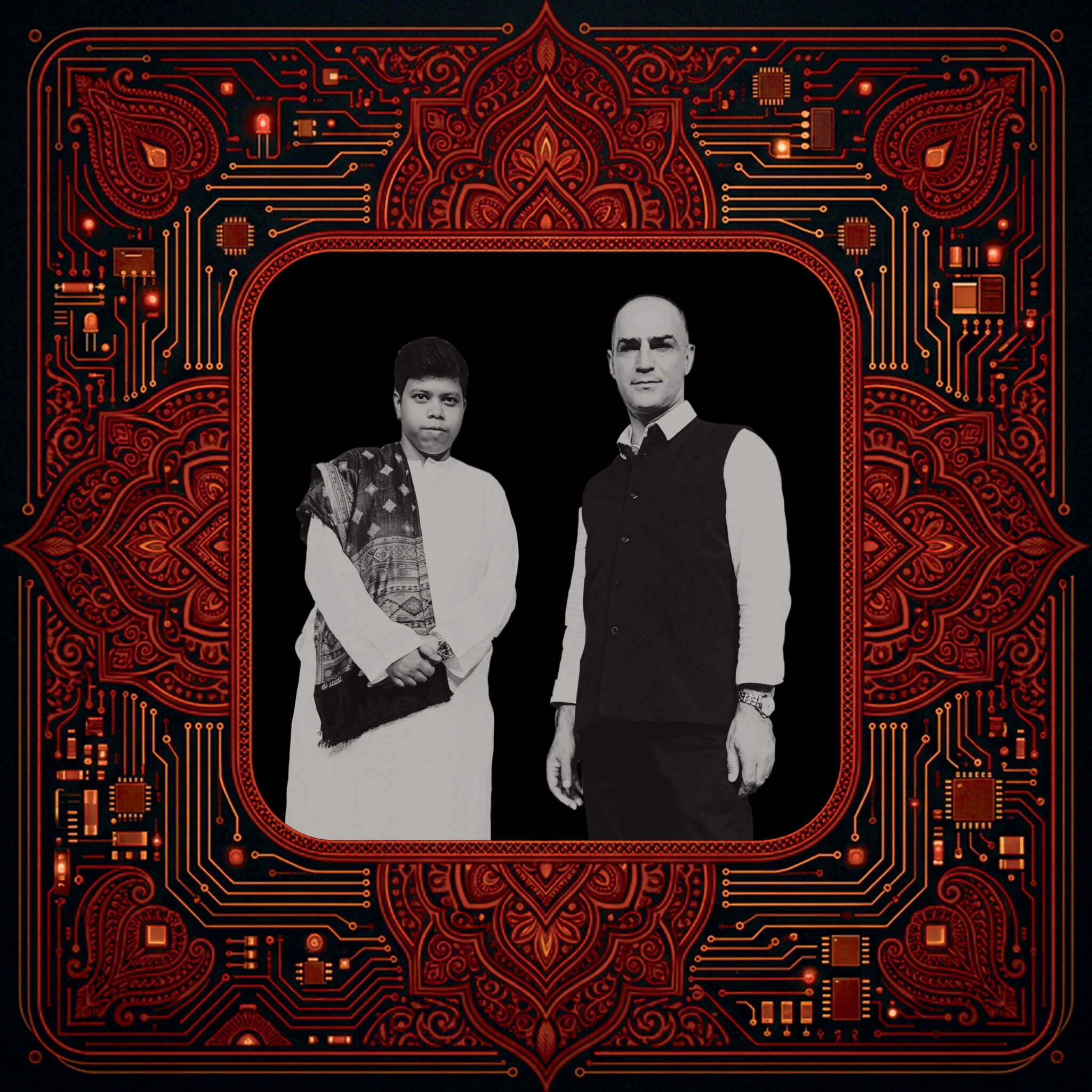
In its third installment, SHAKTI Volume 3 emerges as a striking continuation of a cross-cultural collaboration between Kolkata-based vocalist and multi-instrumentalist Sukanya Chattopadhyay and French-Iranian composer and interdisciplinary artist Arashkha Khalatbari. Curated under the vision of EarthSync founder Sonya Mazumdar, the project stands as the third chapter in an evolving dialogue between traditions, geographies, and experimental electronic sound design.
Across its three tracks, the release is an experimental collection that fuses pulsing synth structures with spiritual vocal lineages drawn from across India, Bangladesh, Lithuania, and Réunion Island. The result is not a fusion in the superficial sense, but a layered excavation of shared emotional and mythological ground, where ancient devotional forms meet contemporary sonic architecture.
The EP’s three pieces, Devotional Song From an Urban Ruin, Sweet Surrender, and The Eternal Lily, move through increasingly intense emotional terrain. Together, they explore themes of rebirth, transformation, and femininity, while drawing deeply from Hindustani classical Bandish, Bhajans, Bengali folk traditions, and Lithuanian Sutartinės. The interplay of these influences creates a liminal space where ritual and electronics coexist, each amplifying the other.
Discussing the release, Khalatbari describes a darker and more visceral direction in this chapter of the collaboration:
“With tracks like Devotional Song From an Urban Ruin, Sweet Surrender, and The Eternal Lily, we explored a darker, more urban and intense sonic world. One inspired by the destructive and regenerative energy of Kali. This collaboration is only evolving further, with future projects becoming even more rhythmic, immersive, and emotionally charged. Despite the distance between us, Sukanya and I share a deep creative connection, and we look forward to continuing this artistic journey together across India, Réunion, and beyond.”
That tension between destruction and renewal is central to the record’s conceptual spine. The invocation of Kali as both destroyer and liberator informs not only the thematic direction but also the sonic palette, where distortion, breath, and layered harmonics seem to collapse and reassemble in real time.
Chattopadhyay’s presence anchors the work in a lineage of classical and contemporary hybridity. A classically trained musician from Calcutta University, she has previously collaborated on projects including Amazon Prime’s Made in Heaven, as well as with artists such as Karsh Kale and Burudu. Her approach has consistently blurred disciplinary boundaries, merging regional instrumental traditions with modern electronic and cinematic frameworks.
Meanwhile, Khalatbari’s practice draws from philosophy, sociology, and architectural thinking, most notably through his internationally acclaimed project EKOVA, alongside work spanning theatre, dance, and film. His compositional language often treats sound as narrative structure, an evolving system of social and emotional signifiers.
In SHAKTI Volume 3, this conceptual ambition is expanded further through choreography and visual storytelling. Dance performances by Maeva Curco Llovera and Armande Motais de Narbonne extend the EP into an immersive audiovisual experience, translating sonic tension into physical expression. The result is a work that does not merely accompany movement but actively generates it.
Across its three tracks, the EP also reimagines the Gunkali raga through the lens of self-sacrifice and salvation, while weaving the folk traditions of Lalon Fakir Shah with Lithuanian vocal practices and symbolic references to the lily flower. These elements converge into a shared vocabulary of devotion, femininity, and transcendence.
Listen below: